
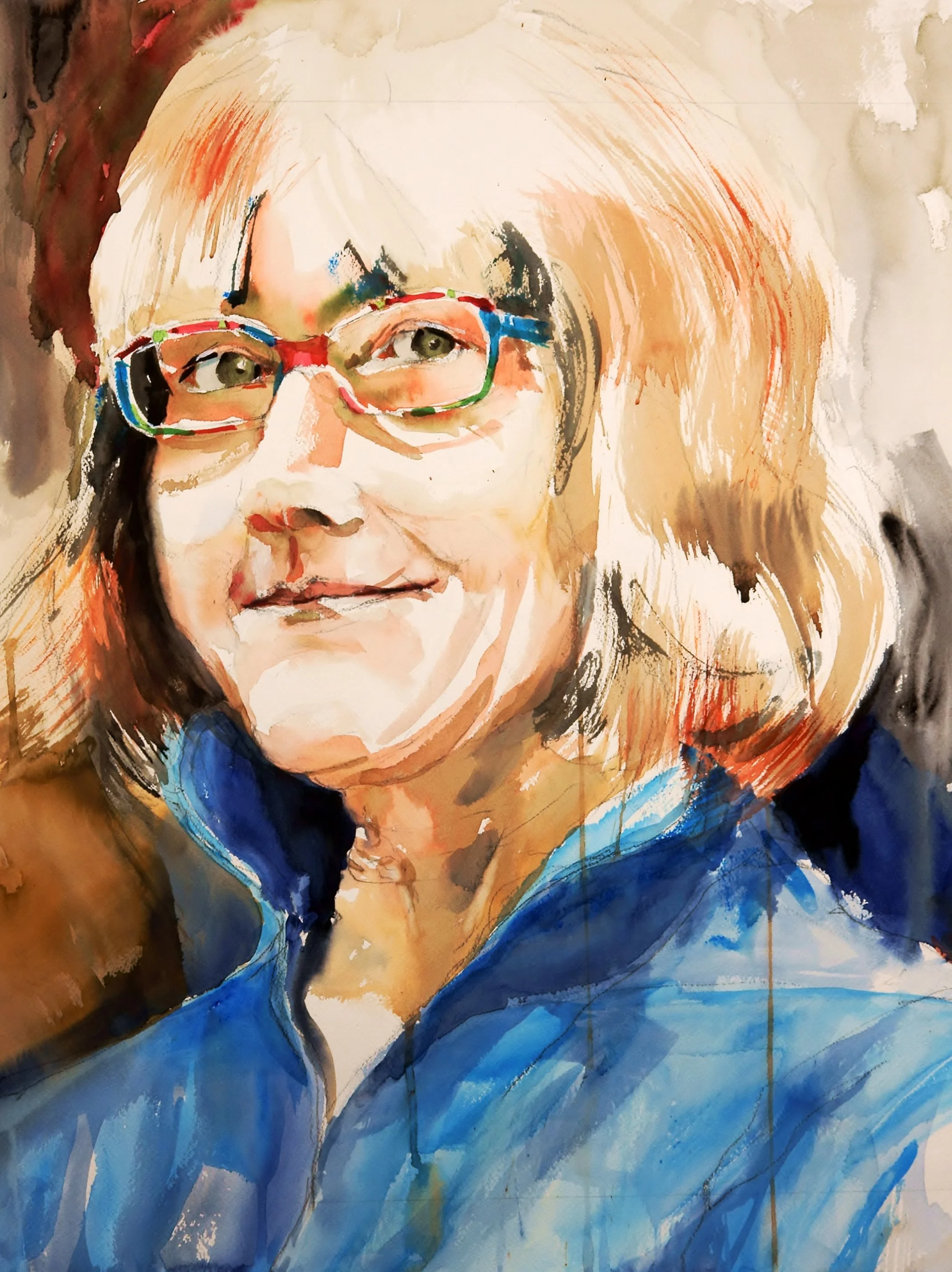
Suze Woolf’s work appears in Trauma and the Environment, Issue 2
What brings you joy? It could be recent or something you’ve enjoyed for ages.
For most of my life, being outdoors in nature has been a sustaining pleasure that has been both joy, whether forest bathing or the spatial rush of alpine summits — and pain, for the threats and changes I see in the woods, meadows, and waters of beloved places.What art form would you like to try at least once?
Anything. I’m always trying something I haven’t done before. My partner doesn’t like to be around then, for there is often a great deal of cursing — but I’d be bored if I wasn’t trying to figure out something new. It’s usually the concept of the piece-to-be that drives which media or form I tackle next.When was the first time you thought of yourself as an artist?
There are days I’m still wondering if I am. I don’t know whether to go back to when my father framed some of my 9-year-old sketches of flamingoes in the zoo, when my Tudor and Stewart English professor let me turn in a painting to demonstrate Spenser’s visual evocations, or when I received some kind of award — like being published here.What’s one way you process or manage painful emotions?
Getting outdoors in natureWhat’s a work of art that has influenced you greatly?
Is there anything one has seen that doesn’t have some impact — positive or negative — to an active observer?What’s your favorite tool for writing/making art?
Watercolor for the way the pigments blend themselves and how the white of the paper always suggests light.If you weren’t an artist, what would you be?
In my scattered career(s), I have already been an editor, a graphic designer, a “futurologist” in high tech, a mom… I am extremely happy to get to be an artist after all those other phases.If you could instantly master any skill, what would you choose?
Meditation for a restless brain!If your workspace could talk, what would it say about you?
“Why do you keep collecting all that junk?” The trouble with being an artist is you never know when something might be useful in a project — or it’s packing and shipping!If you could chat with one artist, living or dead, who would you choose?
I would like to talk to Leonardo da Vinci, for he represents a time when art and science were not so separate, when artists were inventors and theorists as well as depicters.
Learn more about Suze Woolf at https://suzewoolf-fineart.com/